Web3
What a Frontend Developer Actually Needs to Know About Web3
Jun 2026
Web3 doesn't mean learning Solidity first. Here's what actually changes for a frontend dev, and what doesn't.
I kept putting this off, assuming Web3 meant learning Solidity first. It doesn't.
As a frontend dev, your job barely changes. You're still building UI, managing state, and handling async data. The difference is your "backend" is now a blockchain network, which functions as a globally shared, immutable database — slower, public, and impossible to roll back.
Here's what actually matters:
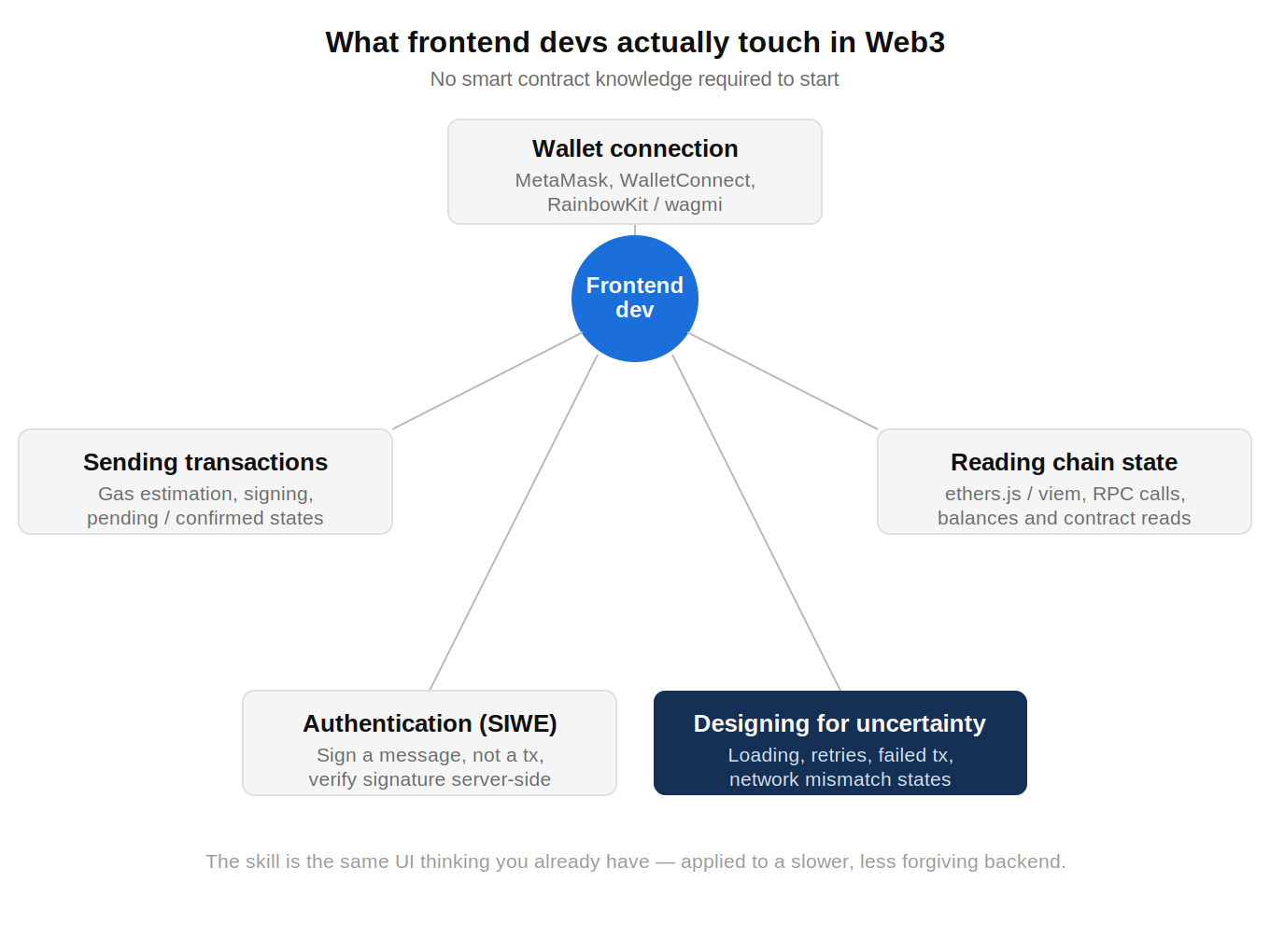
- Wallet connection. Libraries like wagmi or RainbowKit handle this. Your job is the UX around it: clear connect states, network switching, graceful errors.
- Reading chain state. ethers.js or viem replace your typical fetch calls. Balances, NFT ownership, contract data — same caching and loading patterns you already use.
- Sending transactions. This is the real shift. A transaction isn't instant. It's pending, then confirmed (or it fails). Your UI needs to represent that honestly.
- Authentication, the Web3 way. No passwords. With Sign-In with Ethereum (SIWE), the user signs a message with their wallet, and your backend verifies that signature. It's not a transaction, so it costs no gas — but the flow, session handling, and error states are still on you to design.
- Designing for uncertainty. A transaction can sit "pending" for seconds or minutes, depending on network congestion. The user might switch wallets mid-flow, connect to the wrong chain, or have the transaction silently fail. Your job is to make each of these states visible and recoverable — a spinner that never resolves is the worst possible Web3 UX.
The mental model transfers. The patience required is new.