Web3
The Graph vs Goldsky for Frontend Devs
Jun 2026
What frontend developers actually need to know about indexing blockchain data with The Graph and Goldsky.
Smart contracts store data in a way that's nearly impossible to query directly. Want "all NFTs owned by this wallet, sorted by mint date"? Good luck doing that with raw RPC calls.
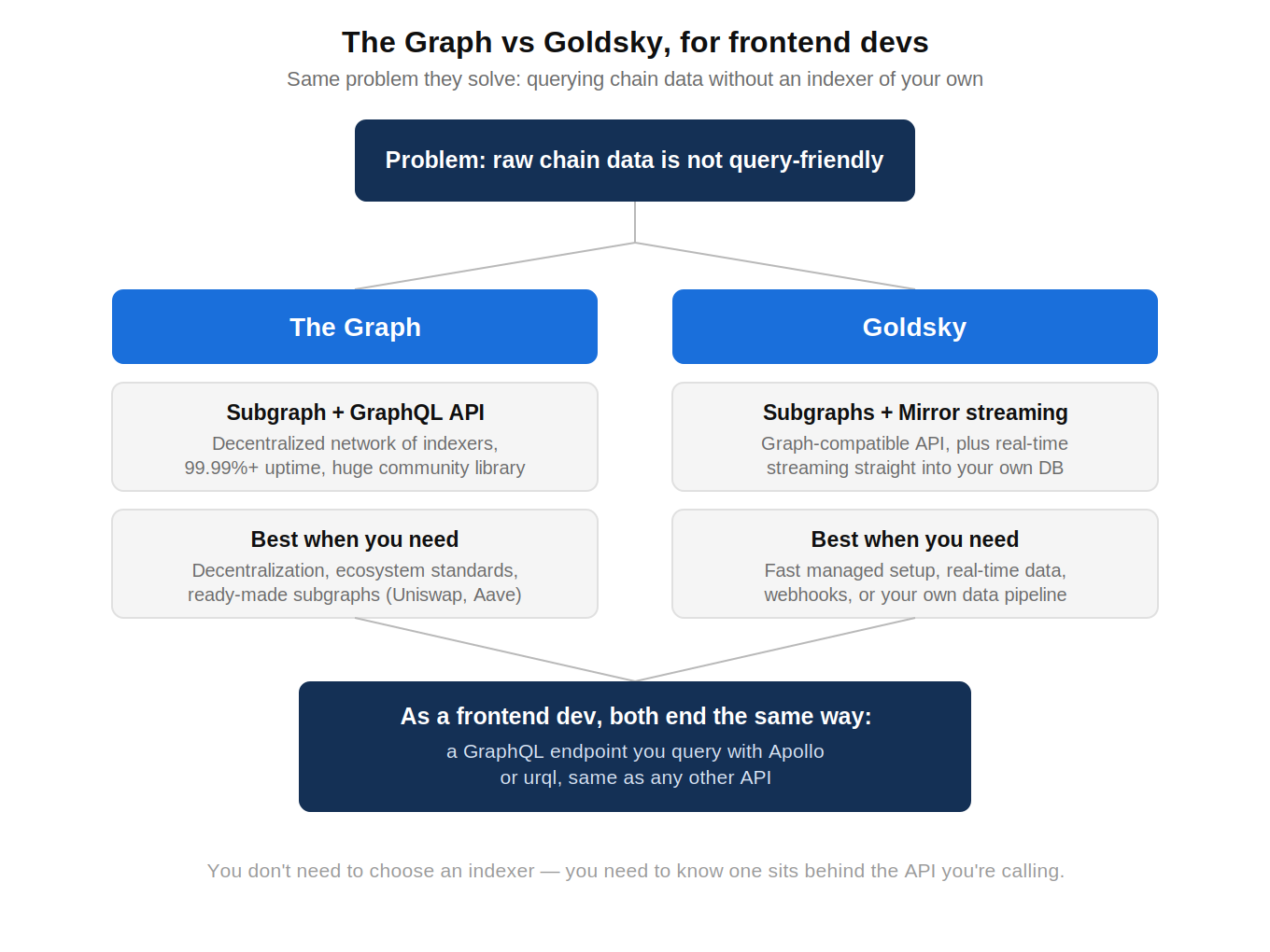
That's the problem both The Graph and Goldsky solve. As a frontend dev, you don't need to operate either — you just need to recognize what's running behind the API you're calling.
- The Graph: a decentralized network of indexers turns contract events into a GraphQL API, called a subgraph. Strong choice when you want community-maintained subgraphs for established protocols like Uniswap or Aave — someone has likely already built the one you need.
- Goldsky: a managed alternative, fully compatible with The Graph's subgraph format. Where it stands out is Mirror — real-time streaming of chain data straight into your own database, no GraphQL layer required. Better fit when you need fresher data or want full control over storage.
- The good news: your frontend code barely changes. Whether the data comes from The Graph or Goldsky, you're still just hitting a GraphQL endpoint with Apollo or urql — the same way you'd query any other API.
What does change is your debugging instinct. If data looks outdated, the cause might not be your code at all — it could be the subgraph still catching up to the latest block (this is called "indexing lag"). If a query is slow, it might be the indexer's infrastructure, not your network tab.
You don't need to operate an indexer. You just need to know one exists between you and the chain, so you ask the right question when something feels off: "is this my fetch logic, or is the data itself behind?"